
On April 23, 2026, Visions and Prometheus-X hosted a webinar focused on a key challenge for universities, training organisations, and EdTech players: how to build intelligent educational services using AI and data spaces.
The webinar brought together stakeholders from education, data, and artificial intelligence around a clear observation. The potential of AI is immense. However, its deployment is still limited by a major challenge: access to data, data quality, and interoperability.
Through expert insights, live demonstrations, and real-world use cases, the webinar explored how to overcome these challenges and move toward truly operational AI-driven services.
Data Spaces: A european perspective to structure educational data
The webinar opened with an intervention by Ioannis Gaviotis, Policy Officer at the European Commission. He highlighted the strategic role of data spaces in shaping Europe’s data economy.
Data spaces provide a comprehensive framework for data sharing:
- technical, through system interoperability
- legal, through contract and rights management
- governance, through control of access and usage
In the field of education and skills, these challenges are even more critical. Data is often personal and sensitive, requiring high levels of security and compliance.
Ioannis Gaviotis emphasised a key point: data spaces are not just a technical infrastructure. They also enable new business models and foster innovation, while ensuring trust between stakeholders.
AI in education: Clear use cases, still limited by data
During the webinar, Matthias De Bièvre outlined the main uses of AI in education and guidance. Two major approaches were highlighted. On one hand, analytical AI is used to assess skills, identify gaps, and recommend training or job opportunities. On the other hand, generative AI enables the creation of learning content, exercises, and personalised feedback.
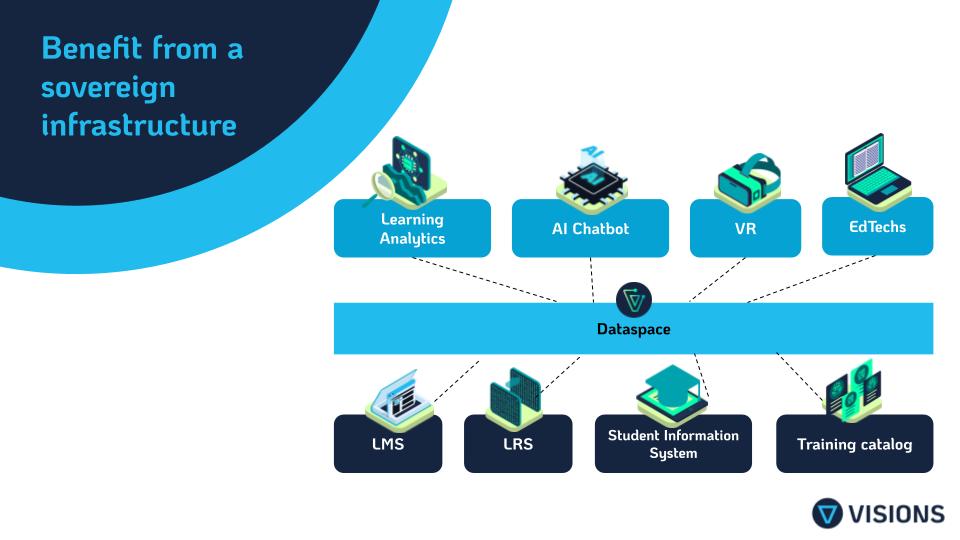
However, these use cases rely on access to diverse data sources. This includes skills data from curricula, student system data such as LMS, and labor market data. In practice, this data remains highly fragmented. It is distributed across multiple stakeholders and often siloed within organisations, limiting its usability.
Matthias De Bièvre also pointed out that data integration remains complex. It involves technical challenges, such as formats and APIs, as well as legal and governance issues, including GDPR compliance.
To address these challenges, solutions such as the Learning and Skills Data Factory and VisionsTrust were presented, in combination with interoperable data spaces.
From data to actionable services
The webinar then moved to a practical sequence, starting with a live demonstration of VisionsTrust by Matthias De Bièvre, followed by the presentation of the Learning Data Factory by Matt Sonnati (Inokufu). The goal was clear: show how to connect multi-source data and activate AI services in a simple and secure way.
VisionsTrust
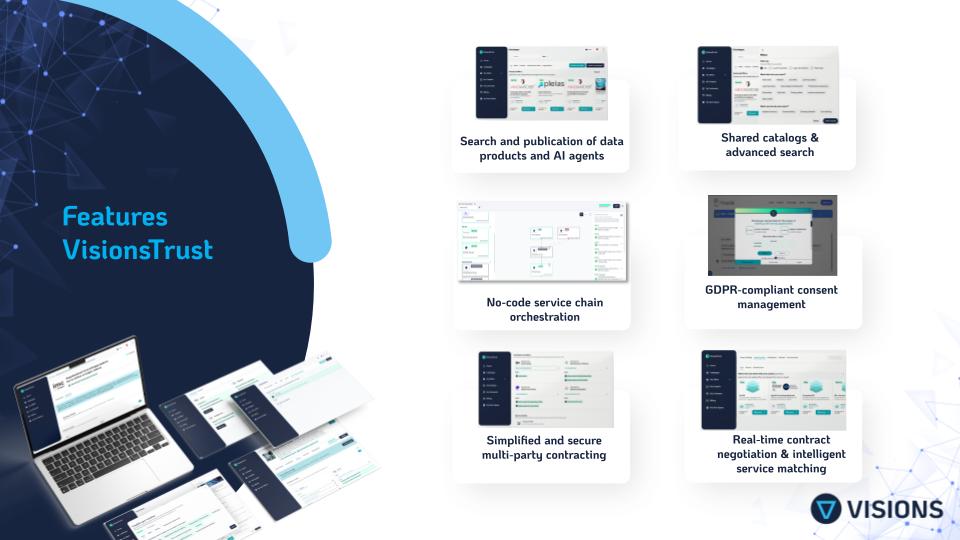
The demonstration of VisionsTrust showcased the platform’s key capabilities:
- Search and publication of data products and AI agents
- Access to shared catalogs with advanced search
- No-code orchestration of service chains
- GDPR-compliant consent and access management
- Secure multi-party contracting and real-time negotiation
VisionsTrust goes beyond system integration. It enables organisations to structure, secure, and activate data usage within real-world services.
Learning Data Factory
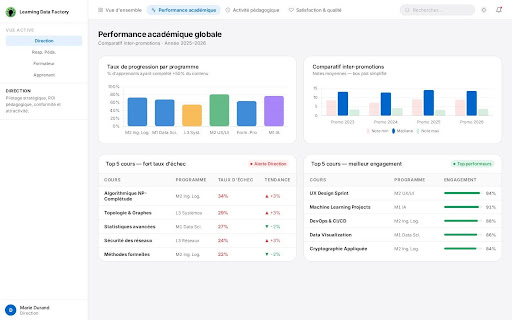
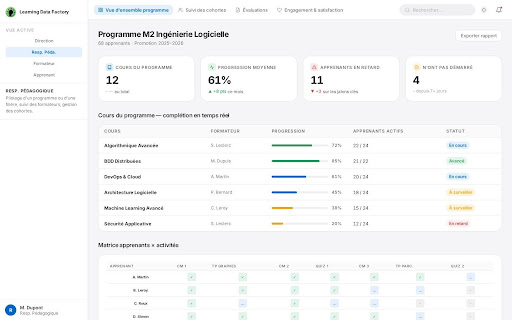
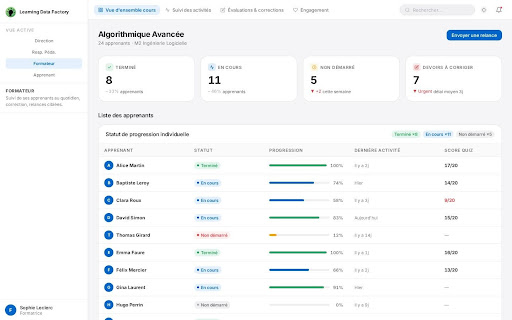
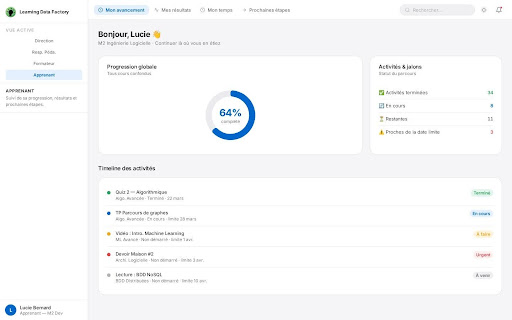
The Learning Data Factory was presented as a solution to leverage multi-source data without complex integrations. Based on a plug-and-play approach, it integrates with systems such as Moodle or Totara via the data space.
The solution of Inokufu includes several key components:
- learning record storage (LRS) connected to the data space
- multi-format data collection (SCORM, xAPI, CSV)
- integration of external data, such as Matomo
- anonymisation and pseudonymisation services
- human support to guide implementation
Data is then centralised and transformed to power dashboards and AI services.
Together, the Learning Data Factory structures the data, while VisionsTrust connects and activates it. Combined, they enable the rapid deployment of interconnected educational services.
3 Use Cases: Concrete applications in education
The webinar continued with real-world use cases, demonstrating how data spaces and AI can be applied in practice.
Generating learning content from trusted data
Inokufu presented a use case involving Open Education Reviews and Edtake. The objective is to integrate reliable data, based on educator reviews, into AI systems.
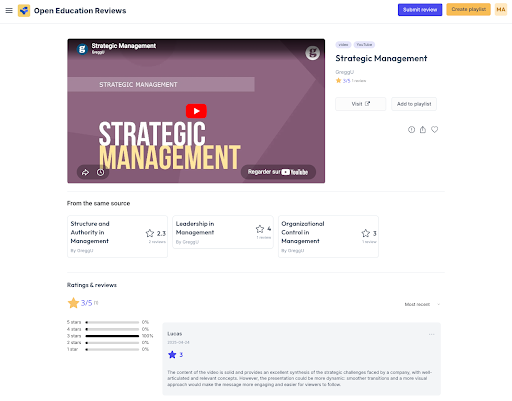
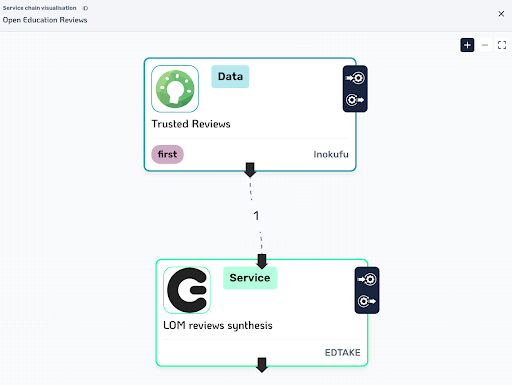
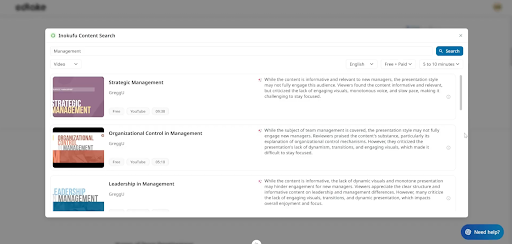
Open Education Reviews acts as the data source. These data are shared via VisionsTrust within a secure and contractual framework. They are then used by Edtake, an AI authoring tool, to generate summaries and help identify the most relevant learning resources.
This use case shows how combining data spaces and AI enables the production of more reliable, traceable, and useful educational content.
This solution is already used by organisations such as Aksis, CCI France, and CCI Normandie.
AI assistants for student guidance and mobility
Essi Kemppainen of HeadAI presented two complementary use cases. The first focuses on guidance with LAB University of Applied Sciences. The second expands the scope to student mobility with the CSC project in Finland.
AI for student guidance
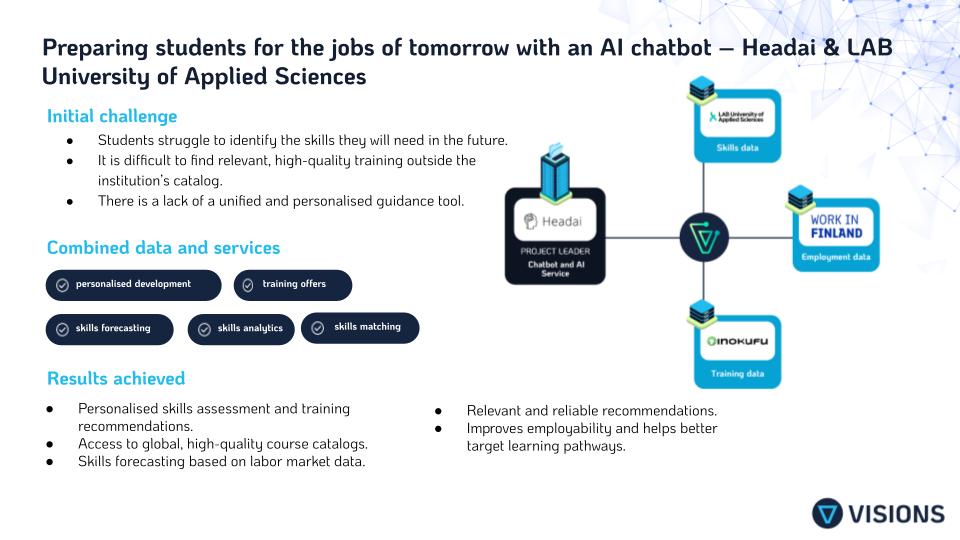
The objective is to help students better understand their skills and identify relevant learning paths. The AI assistant analyses multiple data sources. It combines student skills, available training programs, and labor market data to provide personalised recommendations.
Pilot results are promising:
- 42 students participated
- 4 out of 10 AI recommendations are perfectly aligned with the student’s career path. The others broaden their perspective by suggesting relevant upskilling opportunities they had not previously considered.
- nearly 50% of users rated the experience 4 out of 5 or higher
This use case demonstrates how AI can improve guidance and employability through interconnected data.
Large-scale student mobility (CSC)
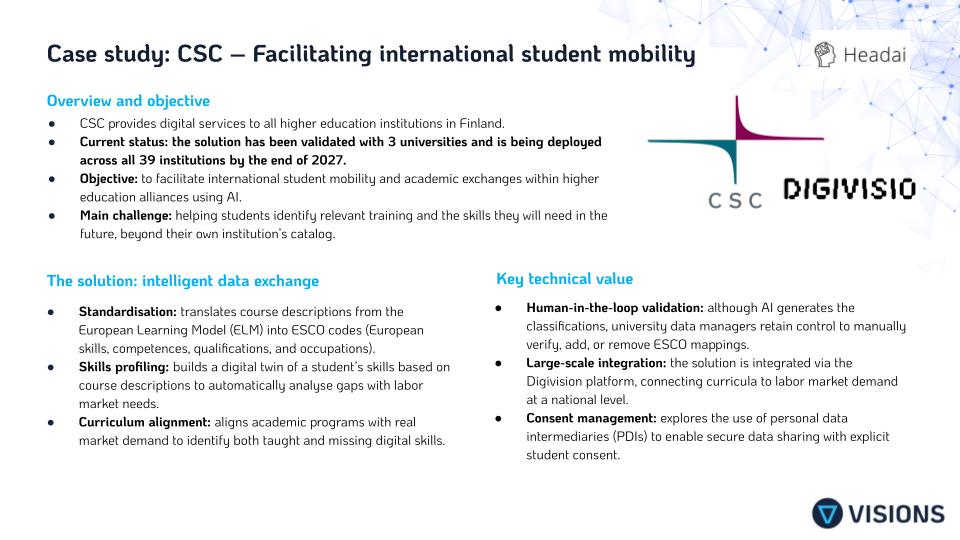
The CSC project in Finland extends this approach to a national level. The objective is to enable students to identify relevant learning opportunities beyond their home institution. The solution relies on data standardisation using ESCO. This enables the creation of a “skills twin” for each student, allowing AI to analyse skill gaps and recommend suitable learning paths.
The solution has already been validated with 3 universities and is being deployed across the 39 higher education institutions in Finland by 2027.
This use case shows how AI can support international student mobility by connecting data across institutions and enabling large-scale personalised recommendations.
In conclusion, this webinar highlighted a key challenge: enabling the deployment of AI in education by improving access to and use of data. Stakeholders are converging toward a common priority: connecting fragmented data to activate meaningful AI services, both for guidance and learning. The demonstrations and use cases confirmed that, thanks to data spaces and solutions such as VisionsTrust and the Learning and Skills Data Factory, this approach is becoming concrete. It is no longer theoretical and paves the way for scalable educational services.
If you were not able to attend the live event, the replay is available below:
Looking to connect your systems, secure and leverage your data, and activate AI services to improve guidance and learning? Contact us at matthias@visionspol.eu to discuss it.