Prometheus-X: digital commons for european data spaces
Prometheus-X is a European initiative that develops the digital commons necessary for creating open, interoperable, and decentralised data spaces. Its ecosystem brings together businesses, public actors, researchers, and developers. Together, they design open-source components and governance models that facilitate secure sharing of data, services, and artificial intelligence. Organisations thus pool their development efforts, accelerate innovation, and build a common infrastructure serving everyone.
As a founding member, Visions actively contributes to the design of infrastructure components, their deployment in European projects, and their adoption within data spaces across many sectors.
 Project objectives of Prometheus-X
Develop open-source digital commons for data spaces.
Build an open, decentralised, and interoperable infrastructure.
Give organisations control over the sharing and use of their data.
Foster the emergence of new collaborative services and artificial intelligence.
Accelerate the adoption of European data spaces standards.
Pool investments to accelerate innovation.
Lightweight, open and interoperable infrastructure
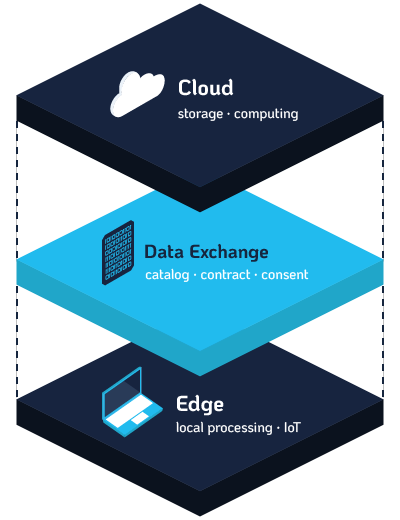
Prometheus-X develops open-source, modular, and easy-to-deploy infrastructure for building European data spaces. It brings together the components necessary to secure data exchanges and allows integration of trusted artificial intelligence services. Furthermore, it protects personal data and facilitates the deployment of processing from cloud to edge.
Additionally, this infrastructure is based on an interoperable architecture and works with other reference technologies such as EDC, SIMPL, or FIWARE. Thus, organisations can connect multiple data spaces without depending on a single vendor or technology.
The components developed by Prometheus-X also serve as the foundation for the Data Space Interoperability Framework (DSIF). This interoperability framework enables multiple data space infrastructures to collaborate without compromising their governance or technological choices.
Components in service of trust
To enable very different organisations to collaborate, Prometheus-X relies on a modular approach. Each organisation can deploy only the building blocks it needs and combine them with its own technologies. Around twenty open-source, reusable, and combinable software components are organised into four complementary families.
Fundamental services
These components form the foundation of any data space. They establish governance rules that enable organisations to collaborate and exchange their data with confidence.





Trusted data sharing
The services in this family secure the lifecycle of artificial intelligence models that exploit shared data. Thus, they guarantee the reliability of processing, the robustness of models, and the protection of privacy, while meeting the requirements of the AI Act.
Data transformation
This family of components converts, structures, and harmonises data from heterogeneous systems to make it interoperable. It particularly facilitates the use of learning and skills data while preserving their context and the confidentiality of personal data.
Utilities
Utilities complement the infrastructure with cross-cutting functions dedicated to validation, verification, traceability of exchanges, and compliance with governance rules. They thus contribute to guaranteeing the quality and reliability of data exchanges.
Contribution from Visions
Visions develops the open-source code of digital commons related to catalogue, contract, and consent.
Visions co-builds these commons with a wide community to ensure their alignment with recognised data spaces standards.
Visions leads exchanges on the case study of personalised guidance. We work with stakeholders to define data ecosystems implementing this personalisation: use cases, governance model, economic model, and technical architecture.
Visions concretely implements these digital commons through VisionsTrust, our data intermediary, which enables organisations to access the European data market as a ready-to-use service.
All contributions from Visions can be found on the Prometheus-X GitHub repository.
Current initiatives
Innovation built collectively
Prometheus-X adopts an open-source co-construction model. Rather than developing the same components in isolation, members pool their investments and build together the technological building blocks that data spaces need. This approach accelerates innovation, reduces development costs, and enables the rapid delivery of reusable features for all. The initial work focuses on essential components such as catalogue, contract, and consent. Subsequently, the community progressively enriches the infrastructure with new services responding to the needs of different sectors. Furthermore, governance is based on collaborative operation. Organisations that contribute to digital commons participate in technical decisions, component evolution, and project directions. They thus take part in building the infrastructure rather than depending on the choices of a single vendor.
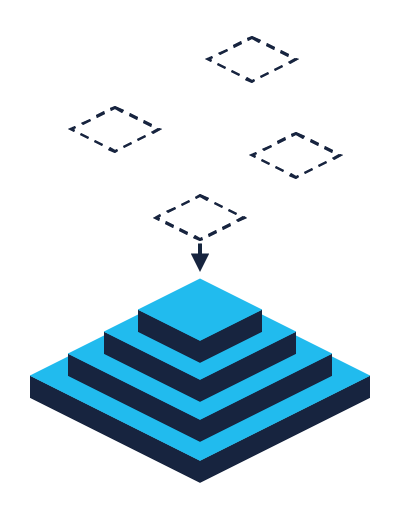
Finally, each contribution benefits the entire community. An organisation that develops a new feature to meet its own need makes it available to other members. In return, it benefits from innovations developed by the ecosystem. This pooling model thus accelerates the development of infrastructure while avoiding duplicating the same efforts in each project.
Participants in the Prometheus-X Project