Our approach to data governance
Europe is building a single data market where organisations can share data, services, and AI models across multiple sectors, while maintaining their autonomy. To achieve this, data spaces must be able to collaborate despite different technologies, governance rules, and contractual models.
At Visions, we believe that this interoperability relies as much on common governance as on technical standards. This is why we contribute to the design and deployment of several European data spaces. In parallel, VisionsTrust, our data intermediary, implements these mechanisms to enable secure, sovereign, and interoperable exchanges.
What we build: Five mechanisms of interoperable governance
To enable data spaces to collaborate while maintaining their autonomy, we apply five complementary mechanisms.





Our contribution to a European governance model
Visions contributes to the development of a common governance and interoperability model in collaboration with several European data spaces, consortiums, and technology partners.
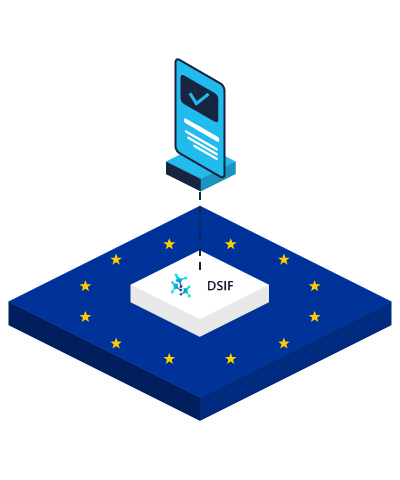
In this context, we are leading the development of the Data Space Interoperability Framework (DSIF). This framework defines the common mechanisms that enable multiple data spaces to collaborate. It imposes neither a unique technology, infrastructure, nor governance model. It also covers the federation of catalogs, the interoperability of contracts, consent, identities, and service chains across ecosystems.
Through this approach, each data space retains its own rules. Thus, it participates in a European data market founded on trust, autonomy, and interoperability.
Governance built collectively
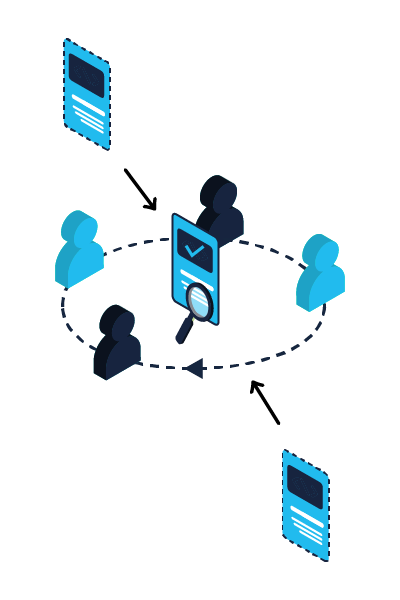
Governance evolves through the contributions of data space operators, technology providers, and organisations that use these infrastructures daily. Governance mechanisms are designed, tested, and improved collectively based on real-world use cases. This approach guarantees continuous evolution of rules, standards, and interoperability mechanisms to meet the needs of different sectors. Rather than imposing a single governance model, this co-construction enables multiple data spaces, based on different technologies and governance rules, to collaborate while maintaining their autonomy. The common mechanisms thus ensure interoperability between ecosystems without calling into question their technical, organisational, or legal choices.
This collaborative governance is one of the foundations of the European data market. It enables organisations to exchange data, services, and artificial intelligence models across multiple data spaces, without depending on a centralised platform or a single provider.
Notre contribution au sein de la Skills Alliance
Cette cellule est principalement composée de membres d’écosystèmes de données partageant des données sur les compétences. Ces réseaux rassemblent des universités, des employeurs, des agences pour l’emploi, des organisations de formation et des plateformes; toutes les données de partage de compétences (offre et demande) par le biais d’un ou de plusieurs intermédiaires de données.
Tous ces organismes collaborent afin de créer le Skills Data Space européen et échange sur les règles techniques, juridiques, UX et économique d’une telle infrastructure européenne.
La Skills Alliance travaille en étroite collaboration avec de nombreux organismes publics dont Europass, Mon compte personnel de formation et le ministère de l’Éducation nationale, de la Jeunesse et des Sports. Elle échange régulièrement avec la Commission Européenne sur la construction de ce projet.
VisionsTrust: The platform that implements this governance
VisionsTrust implements this governance as a data intermediary. The platform automatically applies contracts, usage policies, consent rules, identity mechanisms, and traceability requirements to secure each exchange between organisations.
Through this automation, the entire lifecycle of exchanges is simplified. Organisations discover resources, enter into contracts, control access, track processing, and demonstrate compliance from a single platform. They can thus collaborate more quickly with new partners, without having to develop specific mechanisms for each new exchange.
Furthermore, aligned with the Data Space Interoperability Framework (DSIF), VisionsTrust extends this governance to multiple European data spaces. Thus, organisations collaborate with different ecosystems without modifying their governance, infrastructure, or technologies. They retain their autonomy while participating in a European data market founded on trust, interoperability, and sovereignty.